
Financial management is often an overwhelming task, especially for those who lack accessible tools or consistent motivation to save.
Piggy was created to bridge this gap—bringing community and simplicity to the financial journey: a smart piggy bank and app combination designed to encourage daily interactions, goal setting, and peer-to-peer support for building healthy financial habits.
Our mission is to make financial literacy approachable and habit-forming, especially for those who struggle with impulsive spending or have difficulty committing to financial goals.

Initial Problem Hypothesis
We hypothesized that young adults, especially Generation Z (ages 18-26), have a financial overconsumption issue due to constant social media influence, which resulted in individual budget problems and had a big impact on the environment.
Assumptions
Based on this hypothesis, we made some behavioral assumptions that need to be either validated or disputed through preliminary research:

Testing Our Hypothesis
To validate or refute our initial hypothesis and assumptions, we conducted extensive research using three primary methods: secondary research, surveys, and user interviews. Our goal was to better understand Generation Z’s financial consumption behaviors, motivations, and challenges.
Secondary Research
Providing a comprehensive foundation, allowing our team to understand established theories and trends without initially needing primary data collection.
Defining Financial Overconsumption
Purchasing for hedonistic impulses
Purchasing products of non-renewable resources.
Frequent Behavior Motivations
Instant Gratification
Fear of Missing Out
Mood Improvement
Surveys
Gathering data from a broad audience efficiently and identifying patterns in financial behaviors that might not be apparent through interviews alone.

User Interviews
The biggest theme we discovered from user interviews was how critical peer influence and community collaboration are in shaping people’s financial behaviors.

Refuting Our Initial Hypothesis & Redefined the Design Question
Our findings contradicted our original hypothesis that social media is Gen Z's primary driver of financial overconsumption. Instead, we uncovered the main challenges of emotional factors, peer influence, and lack of consistent financial goals. Based on these insights, we redefined our design question:
How might we help young adults build self-awareness and create meaningful financial habits through achievable financial goals and peer encouragement?
Why This Redefinition Is Neccessary
Our initial assumptions were too narrowly focused on social media and trends. By broadening our perspective, we’ve created a framework that better supports users by addressing the root causes of financial overconsumption and impulse purchases:
Lack of Financial Goals
Users who don’t face immediate financial pressure need shorter-term goals to work towards to feel a sense of achievement.
Consistent Emotional Gratification
Users benefit from feel-good daily reminders and interactions to stay on track.
Peer Support
Community encouragement increases motivation and accountability.
Consolidating our key insights into a goal-oriented persona: Patty.

Placing our persona in an ideal context scenario helps identify the minimum required functions of our MVP.

Integrating peer support into a personal, goal-oriented, and habit-forming experience.
Building on our key findings and the insights from Patty’s goals and motivations, we realized that the ideal solution must bridge the gap between a user’s financial behaviors and their long-term aspirations. To address the challenges of impulsive spending and lack of goal-setting, we focused on creating a system that fosters self-awareness through tangible progress tracking and positive reinforcement.
This leads us to our Design Goals
Frequent
Encourage daily engagement to provide frequent motivation and help users build sustainable habits.
Social
Facilitate social interactions to make sure users know they are not alone on their journey.
Achievable
Support shorter-term goals to reinforce positive financial behaviors and increase users’ sense of accomplishment.
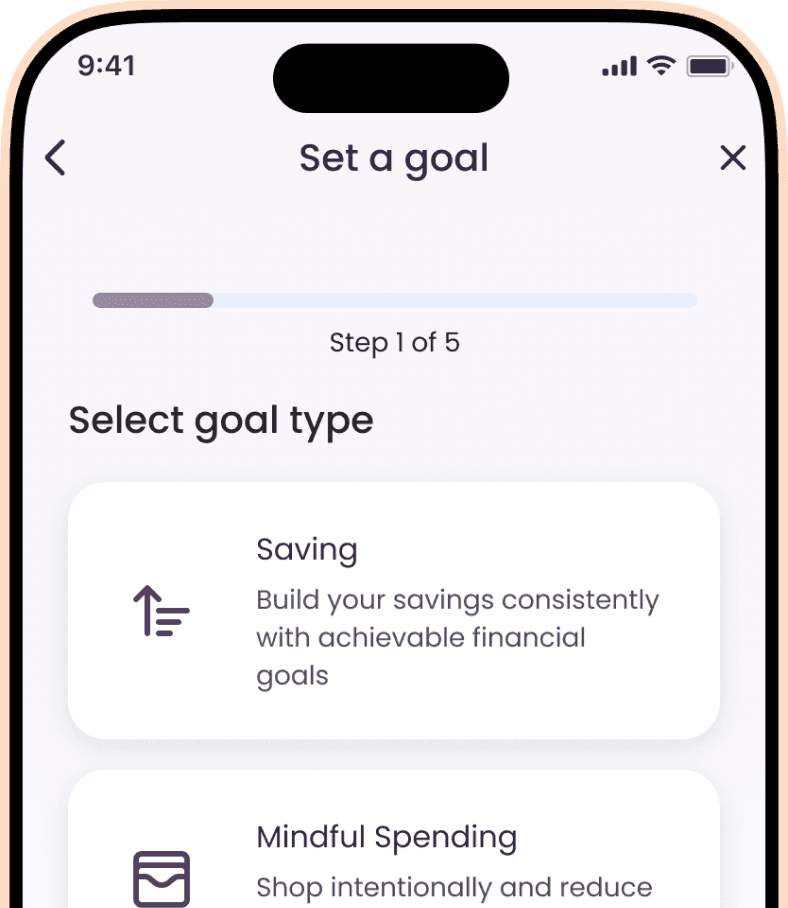
planing our product

Smart Piggy
Interactive, friendly, and tangible, this device allows for daily check-ins and visually engaging progress trackers.
A companion app
The app connects users to their "Piggy Buddies" (friends or peers for accountability), and lets them set achievable financial goals in multiple categories.
Brainstorming Storyboard Requirements
How can our product support our persona’s ideal context scenario?

System Architecture
Informed by our persona's context and needs, we designed user flows that prioritize simplicity and efficiency.
We mapped out the key actions to help users achieve their most common tasks with the fewest steps possible. Understanding that our users are likely managing their finances while juggling other responsibilities, we intentionally streamlined the app’s features, minimizing distractions and keeping engagement focused on the essential tasks that directly support their financial goals.

“I want to set a short-term achievable financial goal to work towards.”

“I want to monitor my daily progress.”

“I want to feel accomplished frequently!”

Iterations Through Usability Tests
Based on feedback from our usability tests with eight participants, we identified critical areas for improvement across Piggy’s physical design, interaction methods, and app features.

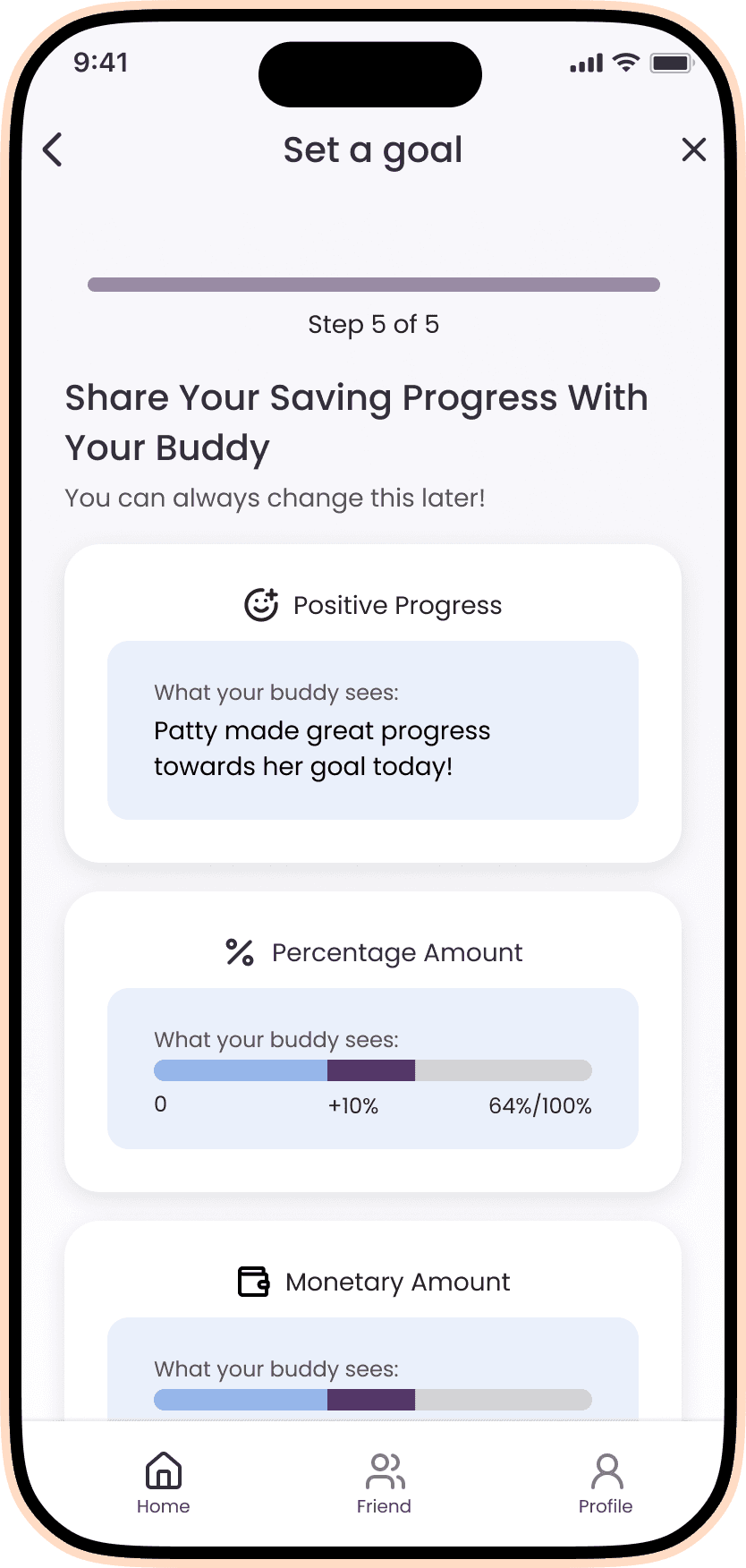
Introducing customization settings for progress disclosure
Most of our usability test participants were hesitant to share their exact spending amounts with their buddies, preferring to share progress percentages or high-level summaries.
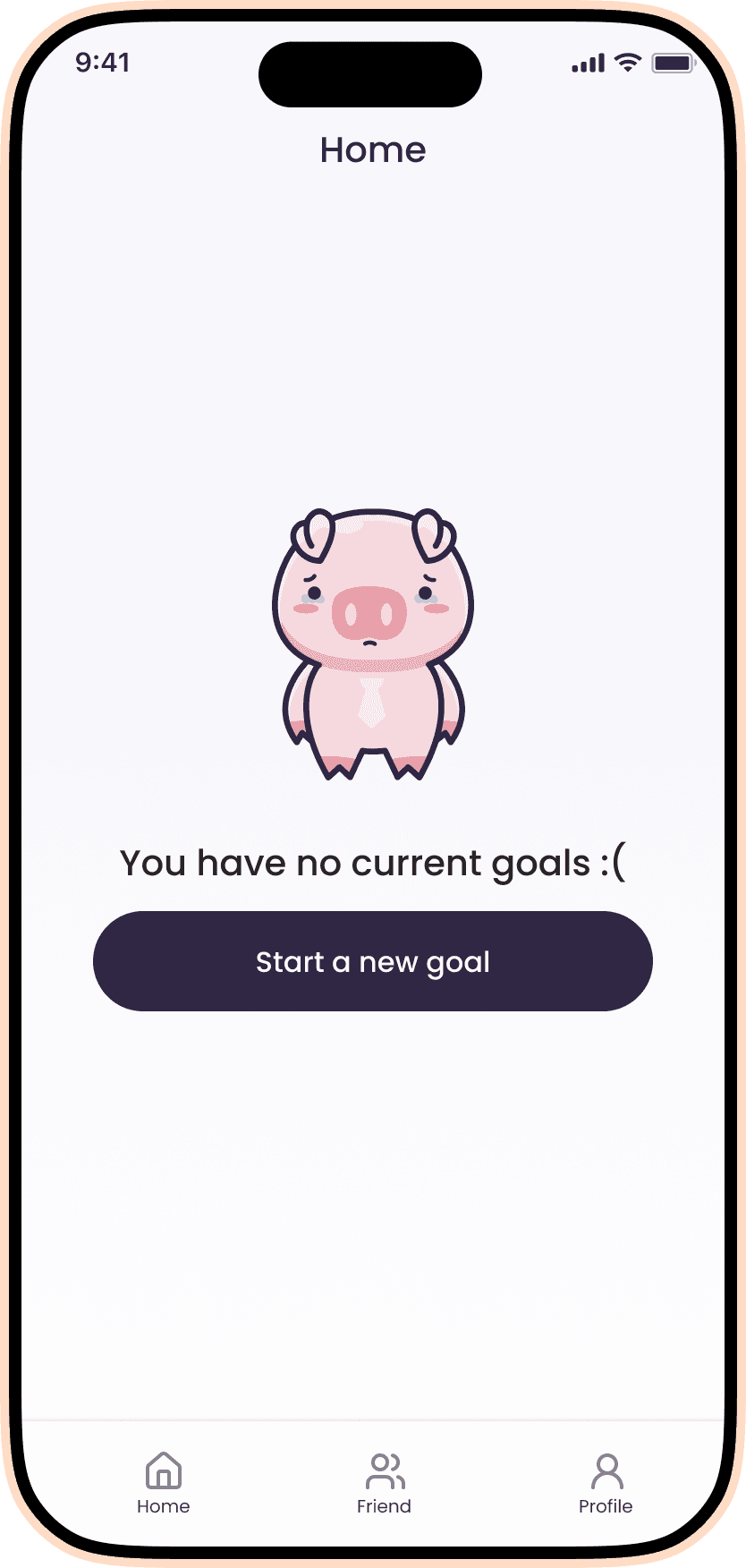
We added a step during the goal-setting flow allowing users to choose what progress details they wish to share with their buddy.
Enhancing clarity on collaborative goals
There was a common confusion among our test participants about how shared goals work, especially how Piggy would divide the contributions between 2 buddies.
We updated the information on this screen to clarify that the user is inviting their buddy to start the same goal type, but their buddy will be able to customize certain aspects of this goal.


Personalizing the goal-setting experience
Participants were confused about Piggy’s Goal Suggestions feature; many preferred to set their own goals.
We redesigned the goal-setting process to prioritize user-defined goals, offering preset suggestions as optional guidance.
Create A Saving Goal

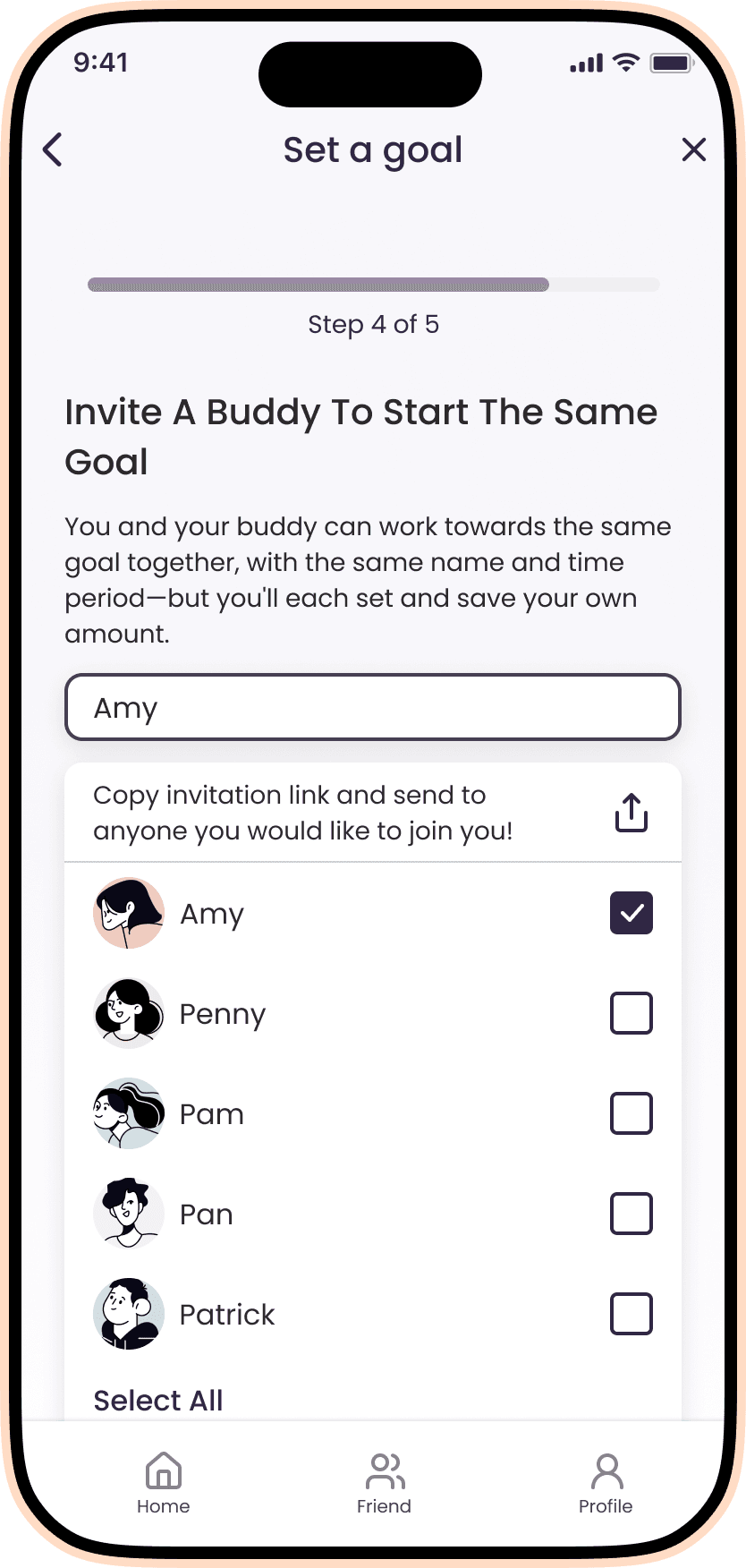
Start Saving with Buddy


Daily Check-in with Piggy


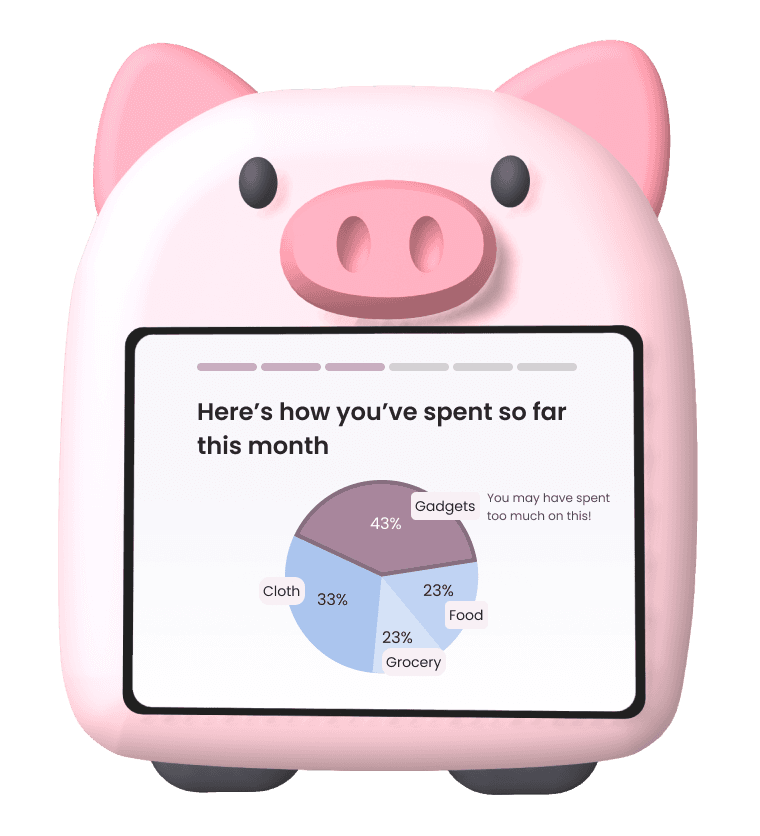
Accompany Your Buddy
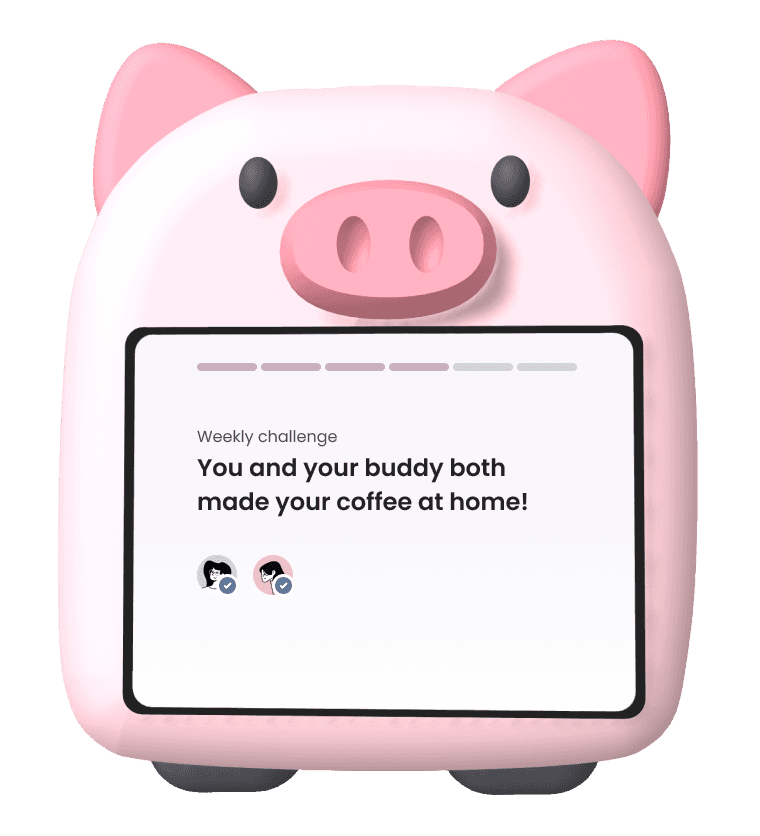


Sometimes a wrong hypothesis can be just as insightful as a correct one, offering opportunities to uncover valuable contextual insights and better connect with users.
At the start of this project, we operated under an incorrect assumption about the motivations of our target users. Through iterative rounds of research and feedback, we learned the importance of challenging our initial beliefs and reevaluating the root of the problem. This process helped us craft a more meaningful design question that aligned with users' needs, motivations, and behaviors. By embracing flexibility and prioritizing empathy-driven design, we transformed missteps into a deeper understanding of the problem space and the people we were designing for.
2025
Reducing hiring managers' credential verification workflow disruptions and extending the MatterWorx design system
/ vendor management system / design system
Sony Electronics
2025
Improve the accessibility and OOBE of Sony LinkBuds Open earbuds for users with visual impairments and dexterity challenges
/ industry-sponsored academic project / usability study